We always feel quite honoured when we are invited to play at Japanese cultural events. Japanese people who live in the UK and hear us play will sometimes come up to us to tell us how much they miss the sound of the drums.
The National Botanical Gardens of Wales and the Japanese Garden Society teamed up and with help from a professional gardener from Kyoto brought new life to the slightly neglected garden. It looked fantastic at the launch. We were invited to play at the opening of the ceremony and then gave a longer performance in the big glass house. We topped it off with pop up workshops for some of the school children that came to take part in the ceremony.
A lot of Taiko has happened in the last few months. We have continued to practice every week as we do, with more emphasis on drills and learning new repertoire with our new members. Yes, we have grown! and the different levels in the group mean we need to take it slower and differently.
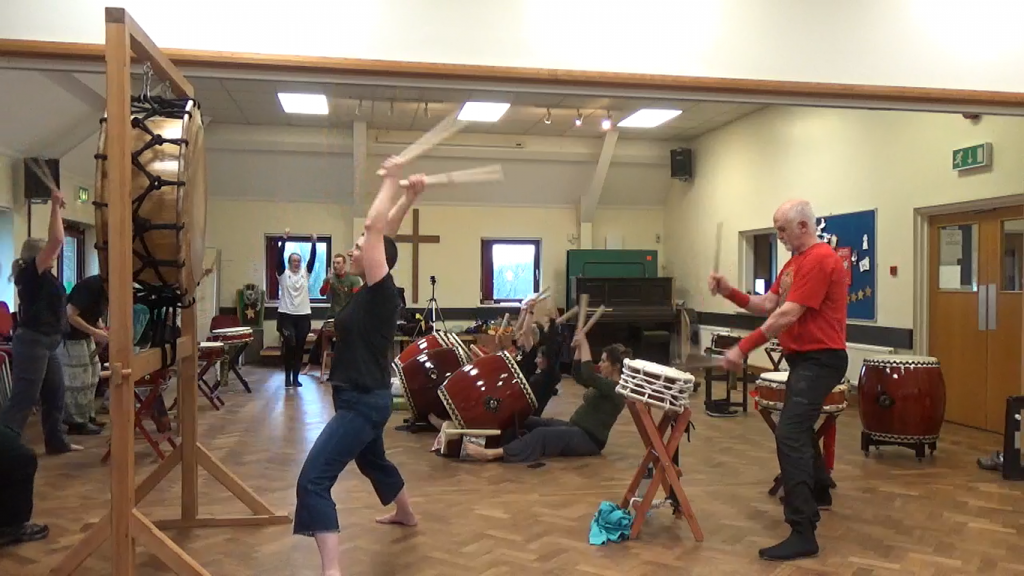
Almost all of Aber Taiko are here – one missing.
But hey, going back to basics is good for everyone – and practice is the place to do so. Reflect on our form, movements, efficiency, power and musicality.
Miyake and Odaiko practice are also going on separately once a month.
And a new style has been added to our journey – Yatai Bayashi. We enjoyed a whole day of teaching from Tsuchigumo‘s Martin and Shonagh.
Learning the yatai bayashi rhythm every which way: sitting down with drums slanted, on the Odaiko, on shime and upright. Then move around, pick a new position and repeat.
With Shonagh and Martin we also had a session on small percussion: the chappa (small cymbals) and chanchiki (handheld metal plate), on shime, movement, and interlocking rhythms. The Tsuchis, as we like to call them fondly, are great taiko players and excellent teachers. They gave us lots of input and so generously.
And a special mention goes to Miyuki Williams, co-founder of Mugenkyo who generously spared almost 2 hours prior to their Swansea gig to teach us some of her philosophy on playing and some Fukui rhythms which we love. She is the source and inspiration to much of the UK taiko scene.
And if we are on the subject of Fukui, we are continuing to learn from Alison Roe, which we all really cherish.
The more we play, the more we have to learn! And we are grateful to each and every one of our teachers who are so generous with their knowledge and time and energy.
We were also quite busy in the gig front – a repeat invitation from the Ospreys got us into the Liberty stadium again. We played for the Swansea Chinese new year’s celebration in the waterfront museum – and gave workshops to the public – and to the mayor himself! and a special gig for us was at Sam’s 7th thank you gig where we helped raise funds for Morrison Hospital’s cancer ward.
At the water front Museum during the celebrations of the Chinese new year.Playing ‘Raku’ in a pub for Sam’s Thankyou eventIn the Liberty stadium, with a ball heading our way!
It has been a long time in the making – but we have now arrived at the point of being mature enough to start learning to play the drums in the Naname style.
Sam made us 4 stands for our Nagados. But of course, the Okedos can also be slanted on the various other stands we have: an x-Miyake stand would do, and the classical okedo stand can also work. And for Hiras there is always a chair that can be tied up.
Okedo slanted on classical stand
okedo slanted on a Miyake x stand
to a chair
Proper slant stands for Nagados
Nagado on a Miyake stand
We asked Ting-Chi Li to teach us. She has been playing with San Francisco Taiko Dojo for many years and has much experience playing Naname. And she has been teaching us before and performed with us in our concert at the Taliesin.
We practiced the basic stance and grip, worked on various drills and finally played the matsuri rhythm together. It was a holistic mind and body day of exercising and learning.